
Williamsport Previous Residents by Era
Previous-residents research works best as a time-bounded address history. Recorded deeds establish a chain of property parties; directory pages and census schedules can place people at a time; maps test whether the address still refers to the same place. The county’s stated coverage is unusually deep for land instruments, yet every source has a different role. Recorded ownership is not the same thing as a full household, and a historic listing does not prove continuous residence.
| Source | Years It Covers | Where Held | What It Shows |
|---|---|---|---|
| Lycoming recorded deeds | 1795–present | Register & Recorder counter and SearchIQS | Recorded transfer chain, legal description, and named instrument parties |
| Williamsport City Directories | 1866–1931 | James V. Brown Library historical archive and library | Directory-year name and address snapshots |
| County marriage records | 1885–present | Lycoming Register & Recorder | Life-event bridge, not address proof |
| County wills | Mid-nineteenth century–present | Register & Recorder and Register of Wills | Estate and representative context where accessible |
| Local newspapers | Daily Gazette 1869–1909; Sun 1900–1955; Sun-Gazette 1955–present | James V. Brown Library archive | Notices, obituaries, and dated address context |
| Federal census | 1790–1950 released | National Archives | Household at one enumeration date |
| Williamsport Sanborn material | 1912, corrected through June 1950; republished 1958 | Library of Congress | Building, block, and street continuity, not people |
County genealogical material also identifies births from 1893 to 1905, deaths from 1893 to 1898, and naturalization papers from 1804 to 1956. Those records can clarify a name or family event, but they should not be used to turn a property history into a list of every past occupant.
Williamsport Previous Residents Start With UPI
Fix one physical address first. Normalize the street direction and suffix with USPS, then use the Lycoming County map channel or Assessment Office to obtain the UPI, the county’s Uniform Parcel Identifier. The Lyco Online property portal makes Parcel Search by UPI public and offers Map Search. Its Owner Search, Address Search, and Advanced Search are identified as subscription routes. Map Search is the useful way to discover a UPI when one is not already known.
The Assessment Office’s official records are at 33 W. Third Street, Williamsport. The office lists 570-327-2301 and weekday hours of 8:30 a.m. to 5 p.m. Public map geometry and a postal address are starting points. Verify the municipality, situs address, legal description, and the exact record at Assessment before treating a map label as proof of ownership or residence.
Lycoming County’s genealogy guidance connects house-history research to the county’s stated historical record holdings.
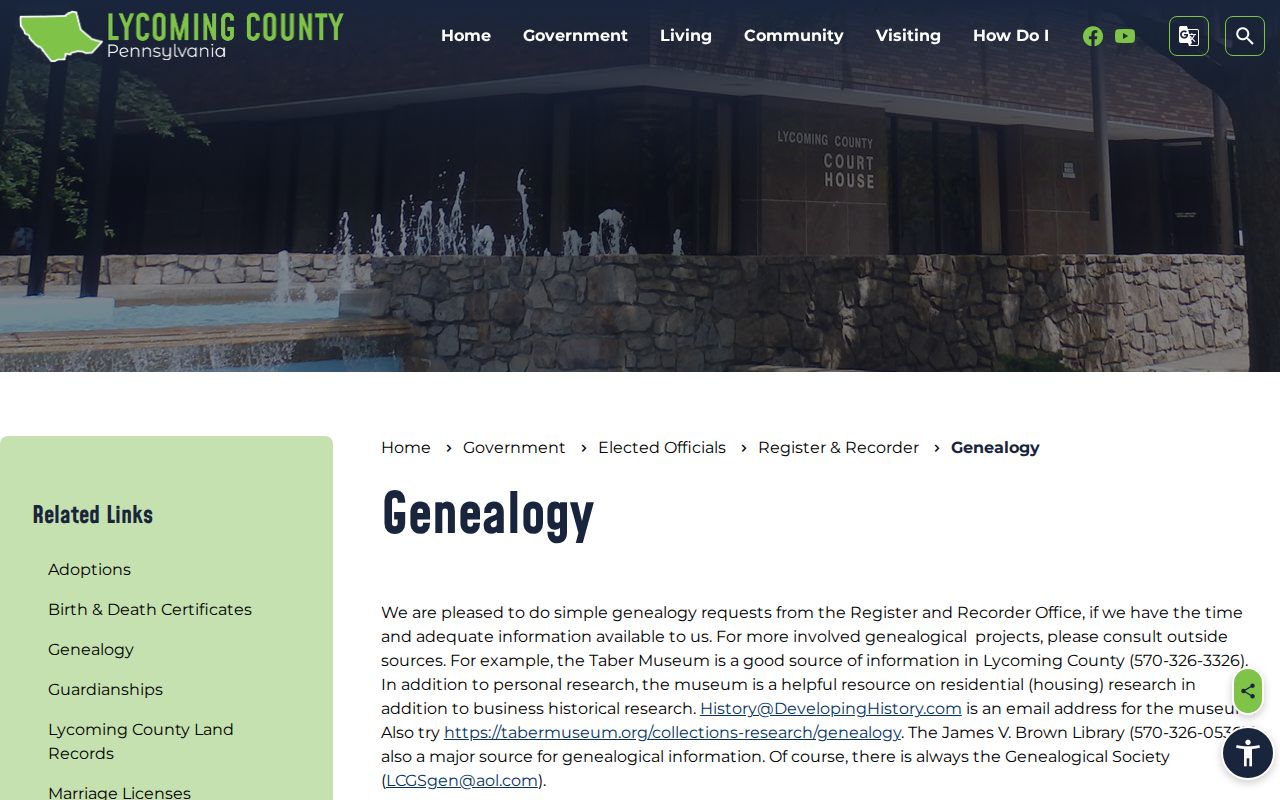
The county guidance helps identify which historical office series can bridge a name or event after the parcel trail is established.
A mailing address in an assessment record is not necessarily where an owner lives. It can identify an agent, estate, business, post-office box, trustee, or another residence. Keep mailing and situs fields separate in notes, then use the recorded deed to verify the current title event.
Williamsport Previous Residents and Deed Chains
For the recorded-property trail, open the most recent deed in Lycoming County SearchIQS. The county says land documents from 1795 onward are available online and during regular office hours. The latest instrument is the pivot: capture the grantee, grantor, recording date, instrument number or book and page, stated legal description, and each prior-reference clause. The prior clause often leads directly to the next earlier transfer.
- Record the normalized present address, UPI, municipality, and legal description from the map or assessment record.
- Locate the latest deed and note its grantor, grantee, recording date, instrument number or book and page, and full property description.
- Search the latest seller, the grantor, as a prior grantee, then confirm the same legal parcel in that earlier instrument.
- Repeat backward, following “being the same premises” or other prior-reference language whenever the instrument supplies it.
- Reconcile UPI, lot, block, subdivision, and legal description at every transfer. Do not join records only because the street number looks similar.
- Call the Register & Recorder at 570-327-2263 when an image is unreadable or a historic book and page needs staff help.
- Grantor
- The party transferring an interest in the recorded instrument.
- Grantee
- The party receiving an interest in the recorded instrument.
- Chain of title
- The sequence of recorded transfers connected to the same legal parcel, checked one instrument at a time.
- Legal description
- The lot, block, subdivision, metes-and-bounds, or other recorded property description. It is the safer bridge when an address changes.
Transfers by estate, sheriff, tax claim, quitclaim, trustee, corporate entity, or correction deed deserve extra care. A surname search alone can miss the reason for a gap. Read the instrument and follow its stated reference rather than assuming that the first matching name completes the chain.
Williamsport Address Continuity Checks
Williamsport has no verified citywide renumbering source in the research record. That absence is important. A changed street number, a parcel split, a merger, or a municipal boundary difference can make a straightforward address search look like a broken history. The research should therefore travel by legal description and UPI, with maps and nearby landmarks used to test continuity.
The Library of Congress describes the local Sanborn material as 59 sheets beginning in 1912 and corrected through June 1950, with a 1958 republication. It includes parts of Armstrong Township, Duboistown, Old Lycoming Township, and South Williamsport. A Williamsport postal or directory label may therefore need a municipality and map check before it is attached to an incorporated-city property.
City Bureau of Codes records can help date an alteration or project at an exact address, if the agency locates a releasable historical file. The city has no verified public results portal for permit or code searches. Call or submit a focused Right-to-Know request naming the address, date range, and record type. A permit applicant or contractor is not automatically a resident.
Note: Legal description and parcel history are stronger continuity tools than a street number standing alone.
Williamsport Previous Residents in Directories
Deeds name parties to property events. They do not identify every person who lived at a location. The James V. Brown Library’s verified Williamsport City Directories span 1866 through 1931, and its historical archive also lists newspaper runs that can support a dated name or address finding. Exact directory entry fields and abbreviations must be read from the actual selected volume, because the collection listing does not display a local sample entry or key.
Pair a directory year with a nearby newspaper search and a released federal census. The census is a household snapshot for its own enumeration date, not a continuous address history. An obituary, probate file, naturalization paper, or marriage record can add family context, but each still needs a date and a clear connection to the parcel or documented address.
- Select the directory year closest to the address event and save the title page, year, entry image, and page citation.
- Search period newspapers for name variants, initials, and the address where the collection permits it.
- Use the federal census for a household at the relevant enumeration date, recognizing that 1950 is the latest released census.
- Compare the address to the deed chain and the Sanborn block or building context before treating a match as the same property.
- Keep a separate label for recorded owner, directory listing, census household, and family reference.
The full collection and volume-access details are kept with the Williamsport city directory records, while this address trail remains focused on connecting a household clue to the right parcel and period.
Williamsport Previous Residents and Census Dates
The National Archives census resources provide the federal layer for household composition. Census access follows a 72-year release practice. As of the research date, 1950 is the latest released decennial census. Use an address only after confirming its historical geography, and record the enumeration year with any name result. A census household can include people who never appear as parties in a deed.
National Archives census research is the official starting point for the dated household layer of Williamsport previous-residents work.
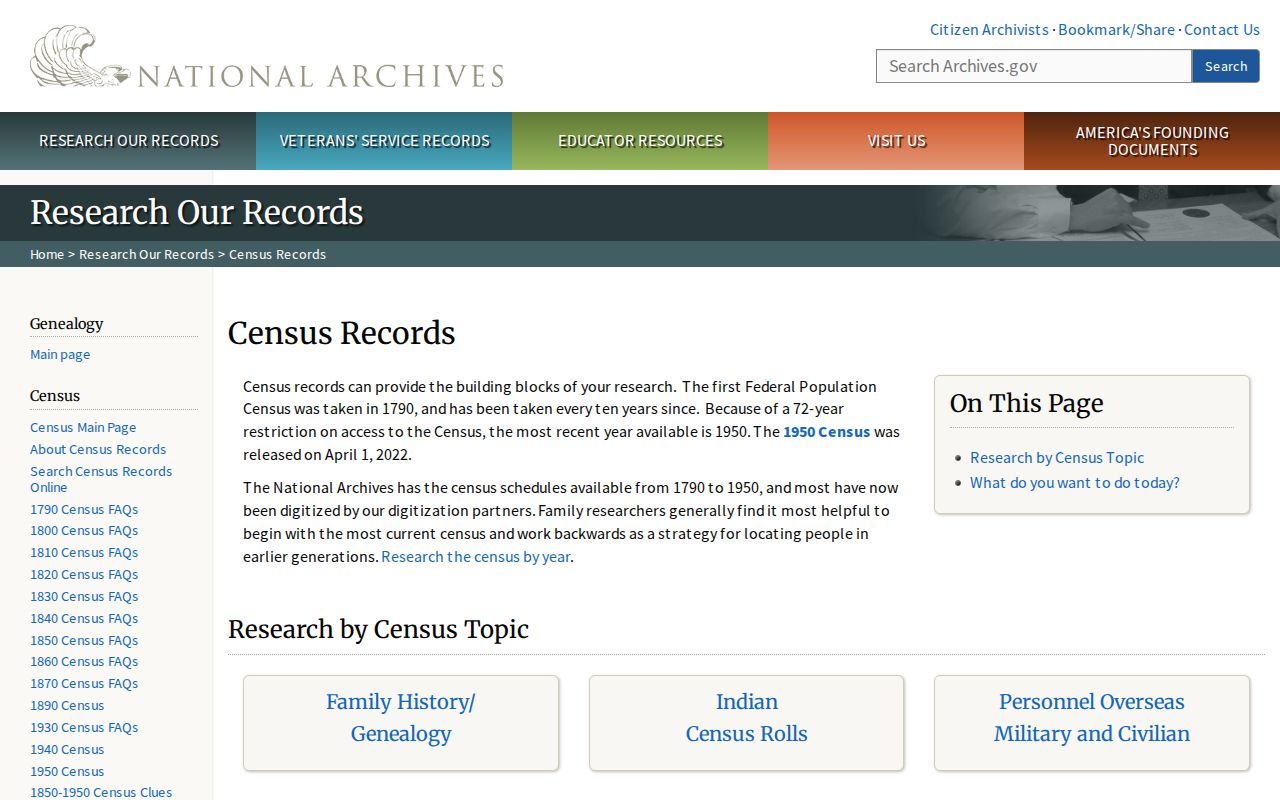
The census adds a household snapshot to the recorded parcel trail, but it does not replace the deed’s legal-description check.
When a directory or census result conflicts with the ownership chain, do not force the records together. Compare spelling, date, municipality, legal description, and map context. The conflict may reflect an estate transition, a changed address, a different household, or a simple indexing problem.
Williamsport Property Alerts Compared
After checking a recorded instrument, a property owner may use the county-linked SearchIQS fraud-alert enrollment page to request email notice when a document is recorded in that owner’s name. The alert is a safety signal. It does not stop a filing, establish valid title, or replace an index search and direct contact with the recorder. Treat a notice as a reason to inspect the exact instrument.
| Recorded deed search | Provides the actual instrument trail, parties, recording details, legal description, and prior references to inspect. |
|---|---|
| Fraud alert | Emails an owner when a document is recorded in the owner’s name; it is not title proof. |
| Recorder follow-up | Helps resolve an unclear image, book and page, copy procedure, or concern about a specific recorded document. |
The recorder-linked fraud-alert signup offers a notification layer after a Williamsport previous-residents deed search.
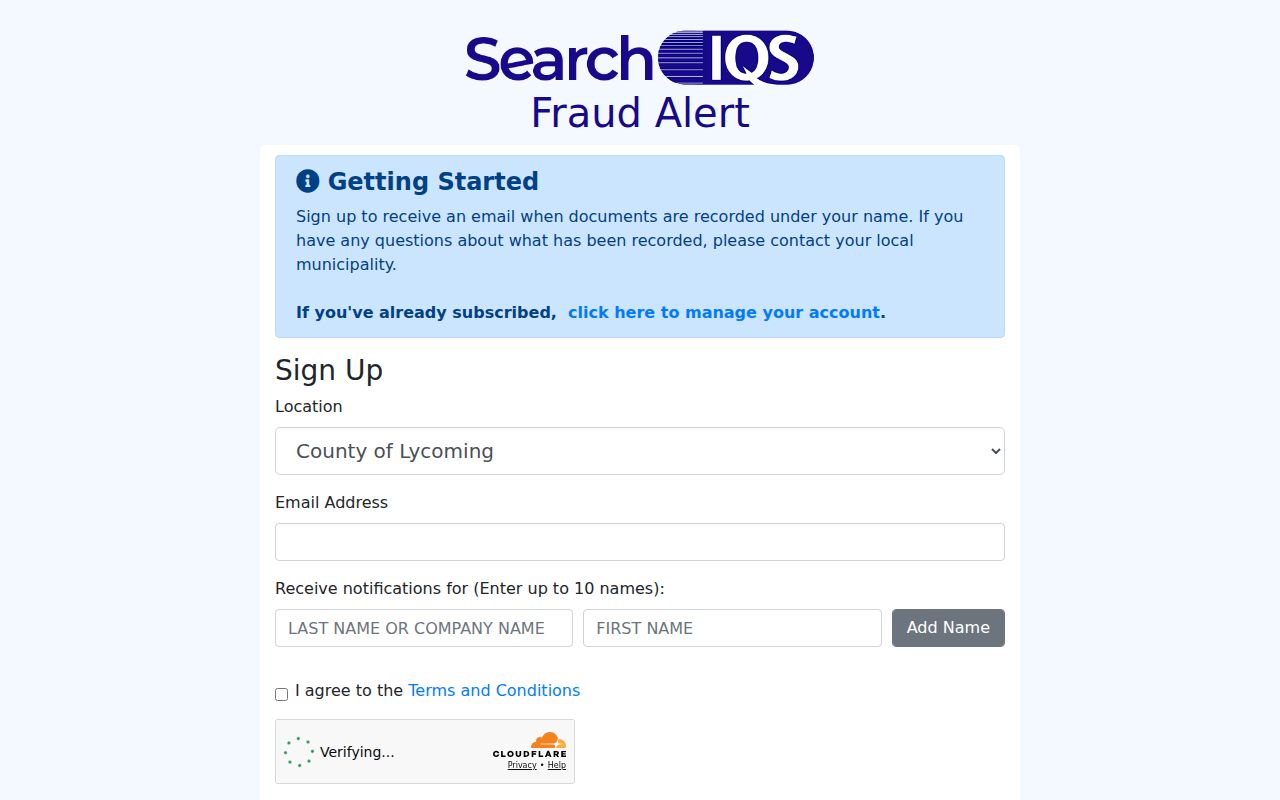
The enrollment screen is useful for monitoring, while the underlying deed and recorder remain the sources for a title question.
Unexpected deed or title solicitations merit the same source-first response: find the instrument number or book and page, inspect the county record, and call the official Recorder number instead of relying on contact details in an unsolicited message.
Williamsport Previous Residents Lawful Use
House history, family history, estate questions, and personal property research are appropriate reasons to follow a documented address trail. Keep results limited to the record purpose and the time period being researched. Do not use a historic listing, map, deed, or household reference to contact, follow, intimidate, or expose a living person.
Lawful use. Use a Williamsport previous-residents trail only for personal house history, family history, or a documented estate question. Pennsylvania’s anti-stalking statute, 18 Pa.C.S. § 2709.1, and harassment statute, 18 Pa.C.S. § 2709, apply even when an old record is public. Do not use these records to stalk, harass, threaten, or harm anyone.
Driver and vehicle information cannot be used to fill an address gap, and protected court or voter information remains subject to its own rules. When a record seems wrong or sensitive, ask the office that holds it about its correction, redaction, or access procedure rather than making an overly broad request for personal details.
Williamsport Previous Residents Office Fallbacks
Online access is one channel, not the whole trail. The Register & Recorder is at 48 W. Third Street, Williamsport, and lists 570-327-2263. The county says its land documents are available online and during regular hours. Ask for help with an unreadable image or historic book and page, and provide the grantor or grantee, approximate date, instrument number, book and page, or property description when requesting a copy.
For parcel verification, use the Assessment Office at 33 W. Third Street. For an old directory or newspaper check, use James V. Brown Library and then Taber Museum if a needed directory year is missing or unavailable remotely. This sequence keeps the address question centered on a real Williamsport property rather than an unsupported list of names.
Note: Save the source image, record date, legal description, and uncertainty note at every link in the chain.