
How Williamsport Street Searches Connect
Lycoming County does not publish one official street-by-street resident roll. A stronger Williamsport street directory workflow begins with the address itself. Use the county map to find the physical parcel and its UPI, then take that identifier to the assessment record. From there, use the recorded-land index to test the ownership trail and use a dated historical directory only for a period-specific name-and-address snapshot. Each stop answers a different question.
- Enter the actual address in the county map route and identify the parcel outline, municipality, and UPI. The map is the bridge from a street location to a parcel key.
- Use the UPI in Lyco Online’s public Parcel Search or contact the Assessment Office for the official record. Record the situs location and legal description as shown.
- Search the current recorded party in SearchIQS, match the instrument through legal description, UPI, or municipality, and save the recording details and prior-reference clause.
- Move backward only when the prior instrument describes the same legal parcel. A street number alone can lead to the wrong lot after a split, merge, or changed numbering pattern.
- For a past period, compare the appropriate James V. Brown Library directory year with maps or newspapers. Treat the entry as dated historical evidence, not proof of every person then at the address.
This sequence distinguishes a recorded owner, a deed party, a mail recipient, and a historical listed name. Those terms are not interchangeable. It also avoids a common error: treating a current map label as a title determination or a current occupancy statement.
Williamsport Street to UPI Map Bridge
The Lycoming Maps & Assessment Records gallery is the practical first stop when an address has no known UPI. Find the street segment, select the relevant parcel, and note the parcel label, municipality, and any legal information made visible in the chosen app. The gallery is useful for seeing adjacent parcel geometry, but visual proximity is not a legal boundary ruling and it is not a household tool.
The Lycoming County Assessment Office guidance supplies the county access information shown below.
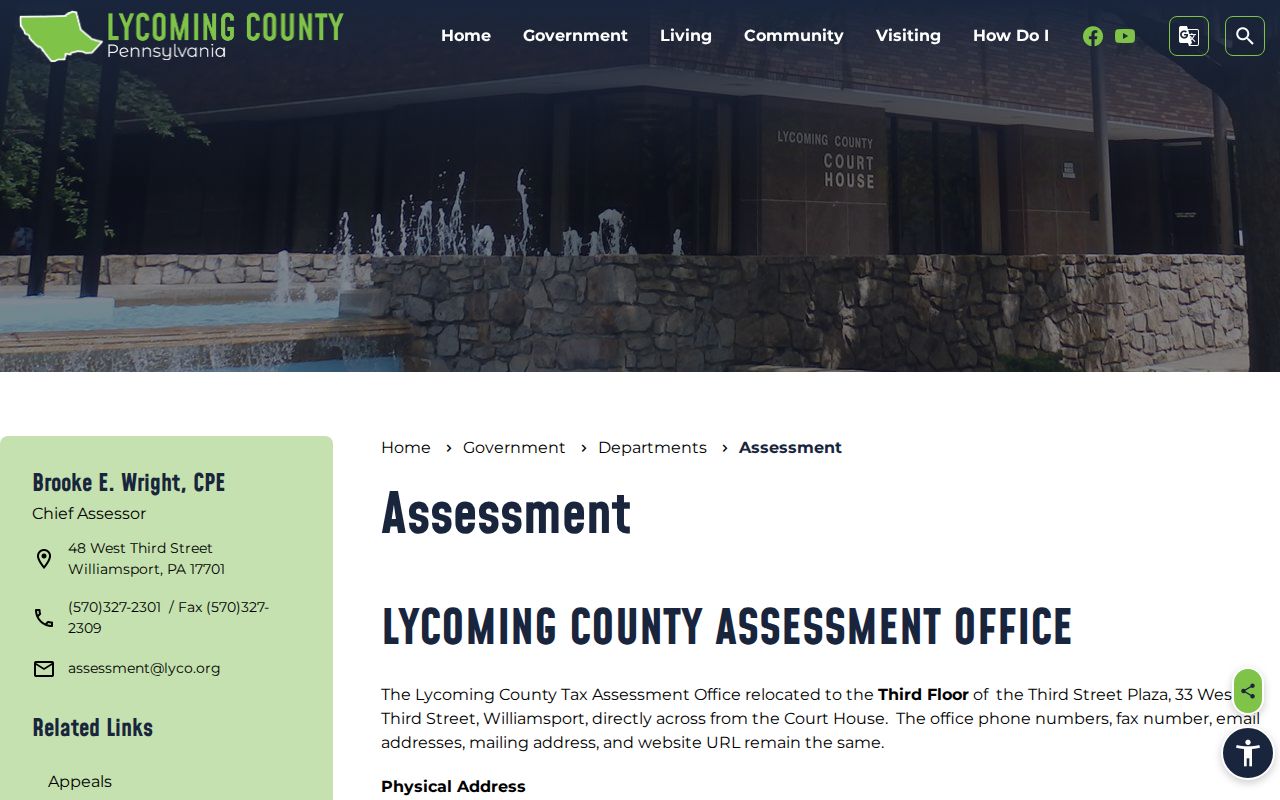
The county assessment material makes the division of access clear: the map helps locate a parcel, while the official assessment record remains the record to verify. A postal Williamsport address can also fall in a different municipality, so keep the parcel municipality alongside the street address before pursuing deeds or city files. If the map label and a record do not agree, retain the UPI and contact Assessment rather than selecting a nearby parcel by appearance.
Williamsport Assessment Search Fields
Lyco Online displays several property-search paths, but they are not equal. Parcel Search takes a UPI and Map Search is the public discovery route. The landing page labels Owner Search, Address Search, and Advanced Search as subscription required. Lycoming County states that broad, criteria-based parcel access has a stated annual comprehensive subscription of $700. Do not promise a free street-address or owner-name search when the portal itself places those modes behind an account.
| Lyco Online mode | Input | Access shown | Street-directory use |
|---|---|---|---|
| Parcel Search | UPI | Public route | Open a known parcel after map discovery. |
| Map Search | Map location | Public route | Connect a street location to a parcel and UPI. |
| Owner Search | Owner criteria | Subscription required | Do not treat as an unrestricted public street tool. |
| Address Search | Street-address criteria | Subscription required | Confirm current terms before using. |
| Advanced Search | Specific criteria | Subscription required | Broad parcel research under account access. |
The Assessment Office is at 33 West Third Street, third floor, Williamsport, PA 17701, with listed hours of Monday through Friday, 8:30 a.m. to 5:00 p.m., and phone 570-327-2301. The department, rather than an older portal floor reference, is the current source for an in-person visit. Ask staff for the current inspection or copy procedure when the online record is unclear.
County tax navigation also points to real-estate taxes, delinquent taxes, and tax sales, but the research did not locate an independent public owner-name tax-roll form. Start with the assessment UPI record, then confirm tax status through the official county tax pages or the current custodian. Do not substitute a tax link for a complete street list.
Williamsport Address Record Coverage
One street can appear in several systems, each with a narrow role. The parcel record anchors the land, the GIS shows orientation, and a deed supplies a recorded transaction trail. The remaining sources add context only when their date and scope fit the question.
| Address record | Custodian | What it can establish | Boundary |
|---|---|---|---|
| Assessment parcel record | Lycoming Assessment Office | UPI, property context, and assessed-record details | Official verification is at Assessment; access modes differ online. |
| Parcel map | County ArcGIS gallery | Parcel geometry, street orientation, and nearby parcels | Not title evidence or a list of occupants. |
| Deed index and images | Register & Recorder / SearchIQS | Recorded parties, instruments, dates, and legal-description trail | A deed party is not necessarily a current resident. |
| Directory collection | James V. Brown Library | Historical name-and-address snapshots in available volumes | Must be read by exact year and entry image. |
| Permit or code file | Williamsport Bureau of Codes | Releasable project or inspection context for an address | No official online permit-result index was located. |
| Election record | Lycoming Voter Services | Individual or list information only within statutory procedure | Not an unrestricted street roster. |
Use the UPI and legal description to join records. Street spelling, direction, suffix, or number can vary across time. Mailing information needs separate care because it can identify a contact point for assessment notices rather than the physical location of the owner.
Williamsport Deed Trail in SearchIQS
The Lycoming County SearchIQS entrance is the current county land-record service. The Register & Recorder says deeds and land documents from 1795 to the present are available online. SearchIQS replaced LandMarc/Avenu on August 1, 2025, so an older instruction may describe a different layout or name. The county office, at 48 West Third Street, phone 570-327-2263, lists office hours of 8:30 a.m. to 5:00 p.m. on weekdays and recording completion from 9:00 a.m. to 4:00 p.m.
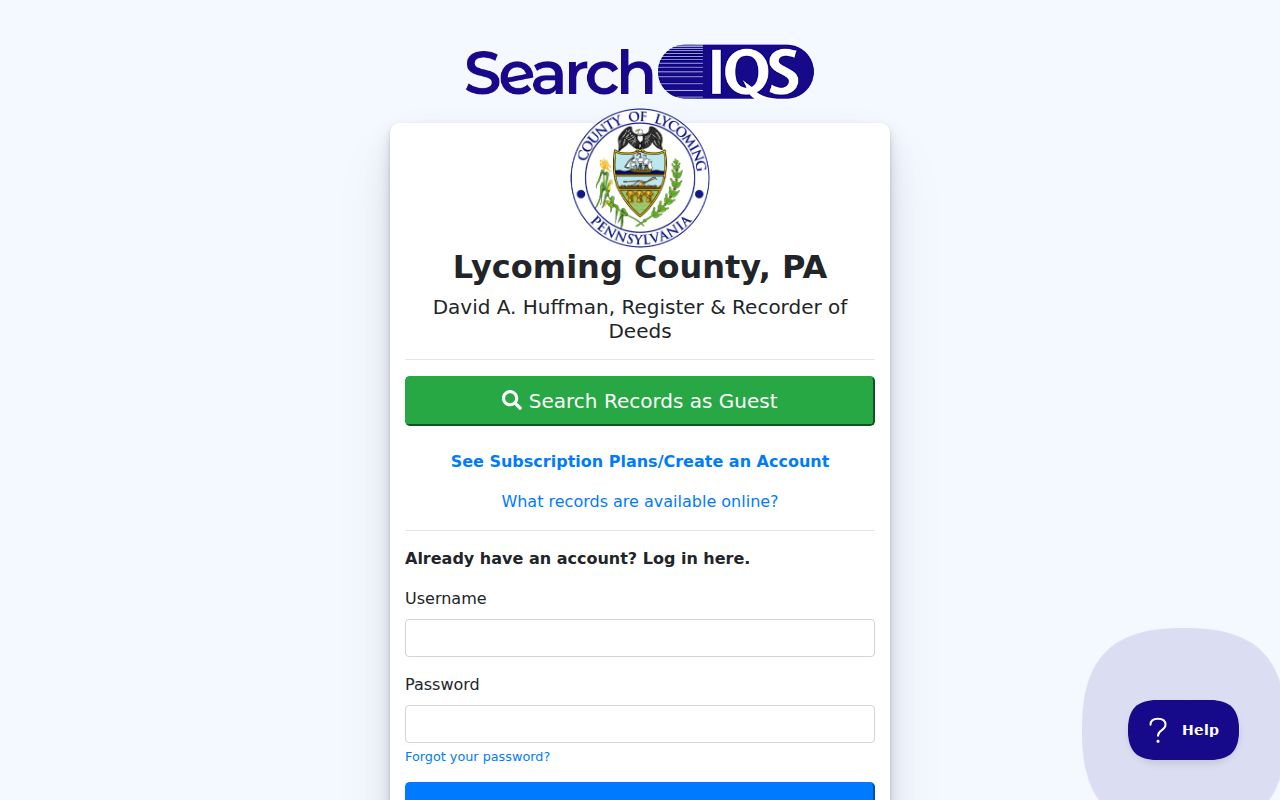
The SearchIQS entry point offers guest search and account options. Once an instrument is located, retain the grantor, grantee, recording date, instrument number or book and page, legal description, and every prior-reference clause. Follow the prior reference, then reconcile it to the same parcel. Estates, trusts, corporations, correction deeds, tax claims, and sheriff transactions can make a simple surname chain misleading.
The Recorder also links a name-based recorded-document fraud-alert signup. It can notify an owner when a document is recorded in that person’s name, but it does not decide title, prevent a filing, or replace an index search. For an unexpected deed solicitation, check the actual instrument through SearchIQS or Recorder staff before relying on the sender’s description.
Williamsport Directory Years by Address
The James V. Brown Library identifies its Williamsport City Directories collection as spanning 1866 through 1931. That is a useful historical layer after the parcel and deed trail are fixed. Select one actual volume, inspect its title page and abbreviation key, save the page image and year, then compare another available year. A gap between volumes does not show an uninterrupted stay at an address.
The collection description does not verify a reverse or criss-cross directory run. Do not claim a street-sorted listing exists for a particular year unless that volume shows it. Library staff or the Taber Museum can help identify whether a given volume has a street section. For older street changes, pair the directory with a map, the recorded legal description, and the relevant deed rather than relying on a name match alone. A Federal Census entry is also a snapshot for its own enumeration date, not continuous address evidence.
Williamsport Codes Files by Address
The City Bureau of Codes handles building, electrical, plumbing, event, and demolition permit processes, along with inspection functions. Its office is at 200 Reighard Avenue, Williamsport, PA 17701, phone 570-327-7517, with listed weekday hours of 8:00 a.m. to 4:00 p.m. and a noon to 1:00 p.m. closure. An address-specific inquiry can ask whether a historic permit or code file is releasable and whether a year is needed.
No official Williamsport online index of permit results or code cases was identified in the research. A permit record may document a project, applicant, contractor, or inspection process. It does not establish who lived there. When a record is not available online, a focused written request should identify the address, date range, and record type, rather than ask city staff to identify occupants.
Williamsport Street Record Terms
Keeping these labels separate prevents an address search from becoming a false identity claim.
- Parcel / UPI
- A parcel is a defined piece of land in the county record system. Lycoming uses the UPI, or Uniform Parcel Identifier, as the stated parcel key.
- Situs address
- The physical property location used to identify the parcel. It differs from a mailing address used for notices.
- Legal description
- The recorded lot, block, subdivision, metes-and-bounds, or other property description that connects deeds to the same parcel more reliably than a street number.
- Recorded party
- A grantor, grantee, trustee, estate representative, or other party named in an instrument. The label records a transaction role, not present residence.
- Reverse directory
- A directory organized from address to name. No verified Williamsport reverse or criss-cross year run was located in the online collection description.
Williamsport Voter Address Boundaries
Pennsylvania’s voter-status service is intended for an individual elector, not a way to assemble a street roster. Under 25 Pa.C.S. § 1404, public-list information and computer inquiries have specific terms. Before obtaining names or information from a public list, a person must provide identification and a written statement limiting use to elections, political activities, or law enforcement. Electronic signatures and SURE registration numbers are excluded from the public list.
Contact Lycoming County Voter Services for its current individual inquiry or list process. A registered address does not establish every person at a location, and voting history does not reveal ballot choices. Protected voters and Pennsylvania Address Confidentiality Program participants may have additional safeguards that cannot be bypassed through a broad records request. The statute’s access rule applies to the requested information and its use, not merely to the moment a list is obtained.
Limits of Williamsport Street Directories
An address chain can document parcel context, recorded land parties, a dated directory entry, or a releasable city file. It cannot prove every person who has been at the address. A mailing address is not a residence finding. DMV information is restricted under the Driver’s Privacy Protection Act, and utility customer information is not a general public address directory. Court sealing rules, protected voter procedures, and address-confidentiality protections also remain in force.
Lawful use. Record availability does not permit threatening, repeated unwanted conduct, intimidation, or harm. Pennsylvania’s harassment and stalking laws, 18 Pa.C.S. §§ 2709 and 2709.1, apply to misuse of address-derived information. Preserve a source citation and use the responsible custodian when a record needs correction or confirmation.